
What Is Disc Degeneration?
Disc Degeneration is a gradual change in the spinal discs that reduces their ability to cushion movement between vertebrae. The process may involve changes in disc hydration, height, or structure. Disc degeneration often develops with aging or repeated physical stress, and imaging findings do not always match the intensity or location of a person’s symptoms.
Quick Facts About Disc Degeneration
Category
Spinal disc condition
Used for
Describing disc structure and function
Common confusion
Not identical to a herniated disc
Also called
DDD, Degenerative Disc Disease
Often discussed with
Herniated Disc Treatment, Back Pain Treatment
Key Takeaways About Disc Degeneration
- Disc changes can occur without matching symptoms.
- Movement patterns help place imaging findings in context.
- Disc degeneration is not the same as a herniated disc.
How Disc Degeneration Works
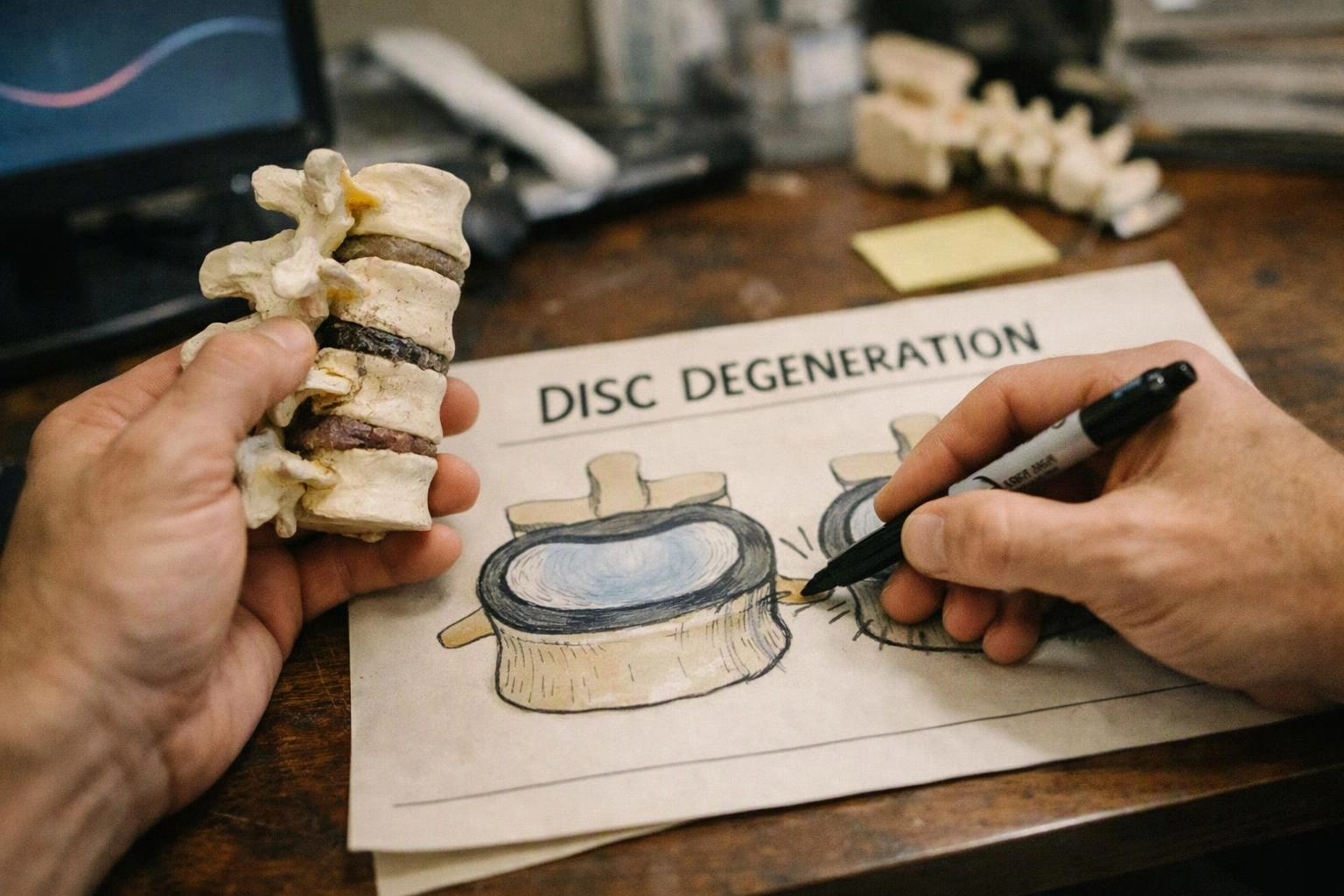
Disc Degeneration describes changes in a spinal disc that can alter how the disc handles pressure and movement. A disc may lose fluid, become less flexible, or reduce the space between nearby vertebrae. These changes can affect spinal mechanics, but an image alone does not establish the source of pain.
Related glossary terms: Lumbar Spine, Nerve Impingement, Spinal Stenosis.
Assessment connects the imaging description with the person’s symptoms, movement, and physical findings. A herniated disc involves disc material extending beyond its usual boundary, while degeneration describes broader structural change. The two conditions may occur together, but one does not automatically mean the other. Treatment planning focuses on the functional pattern, including restricted motion, irritation, or uneven loading around the affected area.

From the Arrowhead Clinic Chiropractor Marietta team
When we assess disc degeneration, we consider the person’s symptoms alongside movement, posture, and available imaging. Our team looks for functional findings that may help explain how the affected spinal region handles daily activity. We keep the disc finding in context instead of treating an image as the whole clinical picture.
Disc Degeneration in Practice: A Real-World Example
A person seeking Herniated Disc Treatment may have imaging that describes disc degeneration in the lower back and pain during bending. The evaluation connects those findings with movement restrictions and possible nerve irritation before care is planned.
Related Services
Related Terms
Lumbar Spine
The lumbar spine is the lower section of the spinal column, located between the thoracic spine…
Nerve Impingement
Nerve Impingement is a condition in which nearby tissue places pressure on a nerve or its…
Spinal Stenosis
Spinal Stenosis is a narrowing of the spaces within the spine that may reduce room for…
Range Of Motion
Range Of Motion is the extent to which a joint can move through its available directions…
Arrowhead Clinic Chiropractor Marietta
Have Questions About Disc Degeneration?
Contact Arrowhead Clinic Chiropractor Marietta for practical guidance on Disc Degeneration and related chiropractor work in Marietta.